


Examples of Classroom Learning
In this section of my teaching portfolio, I highlight my commitment to designing hands-on learning experiences that are both developmentally appropriate and academically rigorous. The included lesson examples demonstrate how I engage students in active, meaningful learning that challenges their thinking while meeting them at their individual stages of growth. These samples illustrate my belief that students learn best when they can explore, create, and apply concepts in authentic contexts.

Nonstandard Measurement
Our unit on nonstandard measurement introduces pre-kindergarten students to foundational math concepts through hands-on activities, including measuring with wooden blocks as a whole group, partner-based Unifix cube line measurements, tracing shoes and using stickers to measure, and using yarn and sticky notes to measure and graph students' heights. This engaging approach fosters early measurement skills and data comparison.

My Five Senses
In our Five Senses unit, students explore sight, sound, smell, taste, and touch through a variety of engaging activities and science experiments in both whole-group and small-group settings. During one whole-group activity, we sat in a circle and passed around a container holding a hidden object, listening carefully to the sound it made before matching it to a corresponding photo. In small groups, students used their sense of smell to explore scented markers, deciding whether they liked each scent or not. They also used their sense of touch to match balloons filled with different materials to the correct pictures, identifying textures. At the end of this unit, we send home a family project for students to practice using their five senses at home and engage families in learning.

Life Cycle of a Butterfly
In our Life Cycles unit, students explore the stages of growth and change by observing butterflies from caterpillar to adult. Using science tools such as magnifying glasses, they make close observations and record their findings in journals, tracking progress over time and noting each stage of the life cycle. Through this hands-on experience, students deepen their understanding of scientific concepts like metamorphosis, sequencing, and the needs of living things. The unit concludes with a special event—releasing the butterflies into nature—allowing students to witness the final stage of the cycle and reflect on the journey they observed from start to finish. As an extension we also researched what types of flowers the Monarch butterflies are attracted too and planted them in our garden.
Literacy Small Groups
In addition to daily whole-group literacy instruction—which may include a read-aloud, shared reading and writing, letter introduction, phonological awareness, or phonics lessons—I implement daily small group instruction tailored to students’ specific needs. Using ongoing assessment and data tracking, I form flexible groups to target and reinforce essential literacy skills. These small group sessions are intentionally designed to be interactive and hands-on, allowing students to actively engage with the material in meaningful ways. The enthusiasm students bring to these lessons not only fosters a positive learning environment but also enhances their progress, making small group instruction a vital and effective component of my literacy program.


Trace, Say, Build
Students take turns feeling each sandpaper letter, describing its strokes together — “Slant down, slant down, line across”— then bring it to life with Wikki Stix.
Sensory Writing
Writing in the sand engages sight, touch, and movement — helping students strengthen fine motor skills, reinforce letter formation, and make learning to write a truly sensory experience.
Line by Line Learning
Students explore how letters are made by identifying their lines and curves — like the letter p with one straight line and a curve at the top. Using wooden shapes, they build each letter, then top it with pom poms for a fun, hands-on way to reinforce letter shapes and connect them to their sounds — P says /p/… pom pom!"


Guided Writing Practice
Students strengthen their handwriting skills by practicing letters with dry erase markers. Using self-talk and group prompts — like 'Line down, one line on the top, and one in the middle' for the letter f — they build confidence and consistency in letter formation."
Visual Discrimination Skills
Students sort our focus letters for the week, noticing and discussing how each one is different. As they sort, they say the letter name — and for an extra challenge, the letter sound — building both recognition and phonemic awareness."
Stamp & Trace Letters
Students use wooden stamp pieces to build letters on a magnetic writing board. When the pieces are removed, the letter’s outline remains — ready for students to trace, reinforcing letter shapes through both building and writing."
Independent Literacy Practice
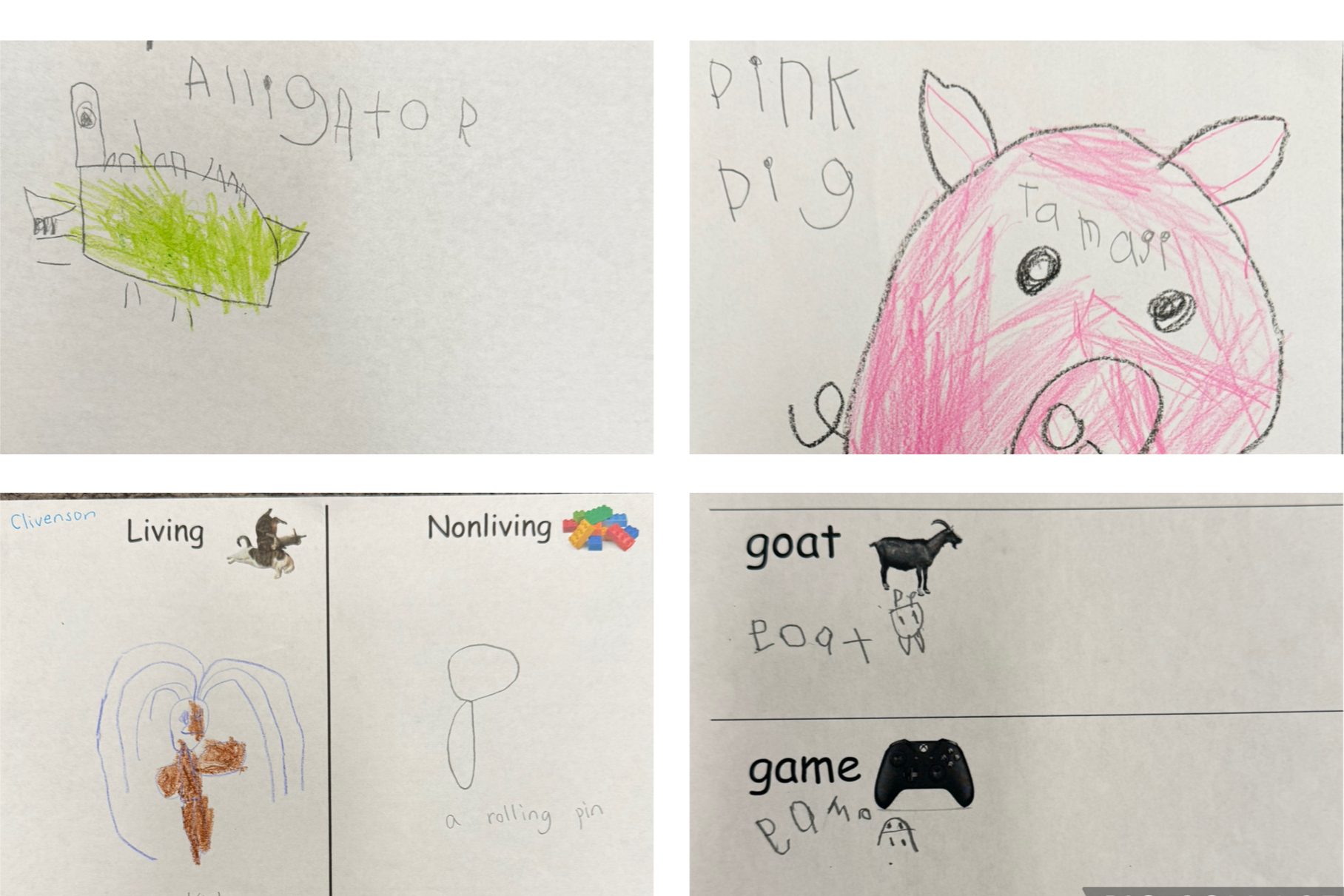
In addition to whole-group and small-group instruction, students participate in independent practice during dedicated center time, allowing them to apply and extend their learning in meaningful ways. Literacy skills are intentionally embedded into centers throughout the classroom, ensuring that reading, writing, and language development are integrated into daily routines. Each day, students engage in a variety of hands-on letter and word activities designed to spark curiosity and deepen understanding. These interactive tasks promote active participation, fine motor development, and phonemic awareness. Daily journal writing is also incorporated, giving students the opportunity to express their ideas and practice the specific writing skills we are focusing on at that time, helping them grow as confident and capable writers.


Featured Lessons
Simple Machines
In our Simple Machines unit, preschoolers explored how things move and work through playful, hands-on experiences. We introduced the concept of ramps by rolling toy cars dipped in paint down an incline, turning science into colorful art. Using pipettes to drip paint on an easel ramp allowed children to see how gravity helps objects move, while also strengthening fine motor skills. We extended the learning by building our own cars, discovering how wheels and axles make movement easier. These activities encouraged curiosity, problem-solving, and collaboration, while laying the foundation for understanding basic engineering concepts in a fun, developmentally appropriate way.


STEM Challenges
Each week, our class engages in hands-on STEM challenges that encourage creativity, problem-solving, and critical thinking. During our Transportation unit, we explored the question of how and why boats float. Students were introduced to a variety of materials and invited to design their own boats using the engineering design process — first sketching their ideas, then building their creations. The challenge was to construct a boat that could float while holding eight counting dinosaurs. Through testing and revising their designs, students discovered the importance of balance, buoyancy, and material choice, all while collaborating and sharing ideas. These weekly challenges foster curiosity, resilience, and a love for learning through real-world problem solving.
Art Exploration
In our art explorations, students engage with a variety of mediums to express their creativity and connect with the work of influential artists. After learning about Reginald Laurent’s vibrant abstract collages, students created their own layered compositions, experimenting with color, shape, and texture. Inspired by a read-aloud about trailblazing fashion designer Ann Lowe, they designed unique outfits using an assortment of fabrics and materials, exploring pattern, texture, and personal style. We also incorporated photography by using students’ own pictures as the foundation for mixed-media artworks, allowing them to see themselves as both the subject and the creator. These experiences not only build artistic skills but also foster self-expression, cultural appreciation, and confidence in their creative voices.


Social Studies in Action
As part of our social studies and civics learning, students participated in a hands-on voting activity to understand the concept of making group decisions. The class was presented with two choices for what to bring to the park that day — balls or chalk. Each student took a turn casting their vote, and together we tallied the results. While some students felt disappointed that their choice did not win, they demonstrated an important civic understanding: the option with the most votes is the one the group follows. To extend the experience and connect learning with home, students created their own ‘I Voted’ stickers and proudly wore them home to share the process with their families. This activity not only introduced the democratic process in an age-appropriate way but also fostered skills in turn-taking, counting, empathy, and respecting the outcome of a fair vote.